Skip to Primary Content
Please note that miamidade.gov no longer supports Internet Explorer. We recommend
upgrading to the latest Microsoft Edge, Google Chrome or Firefox.
Inside the Miami-Dade Sheriff’s Office approach to school threats
February 13, 2026 —
Miami-Dade Sheriff's Office
Share:

The call came in just before 10:37 a.m. as students at Christopher ColumbusHigh School — and at the nearby St. Brendan Elementary and HighSchool—were in class. What should have been an ordinary school day turnedtenseinan instant, as reports came in of a possible gunman on campus. Studentshidunder desks, closed blinds, locked doors and used tables as barricades.
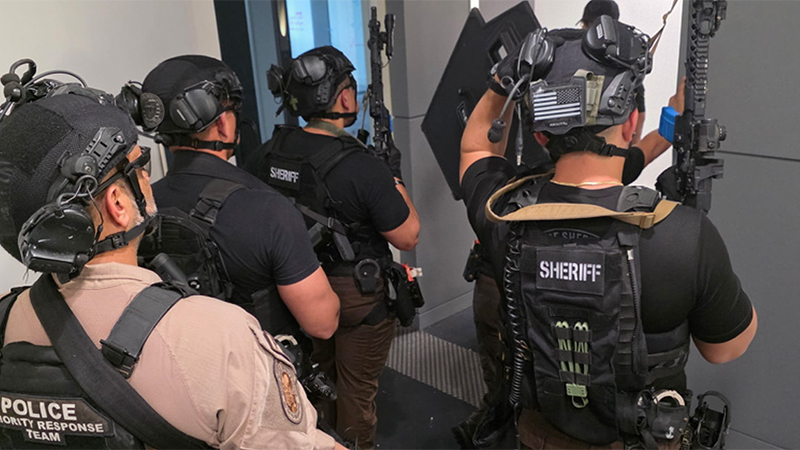
In under two minutes, members of the Miami-Dade Sheriff’s OfficePriorityResponse Team (PRT) arrived at the schools and immediately went inside.
That decision — to move toward a possible threat without delay —reflectsafundamental tenet of how the PRT operates. No time is wasted. If thereisgunfire, deputies run toward it. If there are screams, they runtowardit. These are the scenarios that PRT was created for, followingtheFebruary 14, 2018, mass shooting at Marjory Stoneman Douglas HighSchool in Parkland.
The PRT was designed to handle high-risk incidents, including active shooter situations and terrorism, through rapid, coordinated action.
Teams are strategically deployed across Miami-Dade County, covering both the north and south ends. Training is constant — formal sessions every eight weeks, with squad-level training conducted weekly.
On the morning of February 4, 2026 — nearly eight years to the day afterthe Parkland tragedy — that doctrine was put to the test.
The call would ultimately be deemed a false alarm, but that determination would not come until deputies had been inside Christopher Columbus High School and St. Brendan High School for nearly 11 minutes, moving swiftly through hallways and classrooms as if the threat were real.
Sergeant Edwin Diaz, a team leader with the Priority Response Team, received the alert at 10:37 a.m. He immediately directed two PRT units into motion. PRT 30, based in the Midwest District, was sent to Columbus. PRT 50, based in the Kendall District, headed to St. Brendan.
Each team consisted of six or seven deputies, equipped with ballistic vests, helmets, rifles, breaching tools and shields. By 10:38 a.m., Sergeant Diaz was inside Christopher Columbus High School.
Scouting is a rapid, ongoing assessment designed to locate a threat based on actionable intelligence such as blood or spent shell casings — anything that would direct deputies toward a threat. As deputies moved through the school, they announced themselves loudly as the Miami-Dade Sheriff’s Office. Doors were checked. Hallways swept. Classrooms scanned.
What they did not see mattered just as much as what they did. There were no students running. No chaos in the corridors. Teachers gave thumbs-up through classroom windows. Administrators were visible and composed. The school’s active shooter training — built around the nationally recognized “Run. Hide. Fight.” protocol — was working.
Students were hiding. And they were doing it well. That training is based on the same unforgiving math that guides law enforcement response: buying time. Every locked door and every quiet classroom increases the likelihood that police can reach a threat before more lives are lost. Outside, an incident commander coordinated resources and staging. Inside, Sergeant Diaz relayed what he was seeing, quarterbacking the response in real time.
As deputies continued scouting, additional calls came in. Reports described a person with a gun in a parking lot. Some of those reports were reactions to plain clothes deputies arriving on the scene. Multiple phone calls elevated the response beyond what law enforcement typically sees in so-called swatting incidents — hoax calls intended to provoke an armed response.
Swatting calls occur with some frequency, Sergeant Diaz said, sometimes once or twice a month. Most involve a single call and are quickly identified by the Sheriff’s Office Real Time Crime Center. This one was different.
“Because multiple calls were coming in, we couldn’t rule it out as a hoax,” Sergeant Diaz said. The response remained elevated.
In addition to Columbus, deputies cleared St. Brendan High School using the tactics. By 10:49 a.m., both schools had been fully scouted.
The only reported injuries were minor — students who fell while running in the initial chaos.
Assistant Sheriff Brian Rafky said the response reflected a broader shift in how the Miami-Dade Sheriff’s Office prepares for worst-case scenarios.
“The speed is really a testament to Sheriff Rosie Cordero-Stutz’s vision, ” Assistant Sheriff Rafky said. “Training. Responsiveness. Being there for the community when there’s a threat. When something happens, you can rest assured we’re coming — and we’re coming fast.”
Related News






Leaving Miami-Dade County
You are now leaving the official website of Miami-Dade County government. Please be aware that when you exit this site, you are no longer protected by our privacy or security policies. Miami-Dade County is not responsible for the content provided on linked sites. The provision of links to these external sites does not constitute an endorsement.
Please click 'OK' to be sent to the new site, or Click 'Cancel' to go back.