Know Your Pipes: Miami-Dade County Water Service Line Program
At the Miami-Dade Water and Sewer Department (WASD), protecting public health and ensuring the safety of our community is our top priority. Know Your Pipes is WASD’s initiative to ensure compliance with the Environmental Protection Agency’s (EPA) Lead and Copper Rule and its updates, offering clear communication and resources while prioritizing the health and safety of the community.
Program Background
Know Your Pipes is the Miami-Dade Water and Sewer Department’s (WASD) program to address the U.S. Environmental Protection Agency’s (EPA) Lead and Copper Rule Revisions (LCRR) and Improvements (LCRI). As part of this program, WASD is taking all necessary steps to ensure that our customers have the resources and materials they need to understand the regulations, that the Department provides clear and transparent communication with customers, and that the County is in compliance with all rule requirements. At WASD, protecting public health and ensuring the safety of our community is our top priority. We are dedicated to the treatment and delivery of safe, high-quality drinking water to all our customers.
On Dec. 16, 2021, EPA announced regulatory revisions to strengthen the framework on lead in drinking water. The EPA concluded that there were significant opportunities to improve the rule to support the overarching goal of proactively removing lead service lines and more equitably protecting public health. Part of the requirement was to complete an inventory of the service lines in our water distribution system, which we submitted to the Florida Department of Environmental Protection (FDEP) in October 2024. The initial inventory included numerous service lines that are listed in our records as being made from an unknown material.
LCRI was added in 2024 and requires utilities across the country to update the comprehensive service line material inventory first submitted in October 2024, continue to identify locations with lead service lines, and promptly mitigate risks. Since Know Your Pipes launched, we have been working diligently to identify these unknowns and update our inventory, which is next due in 2027.
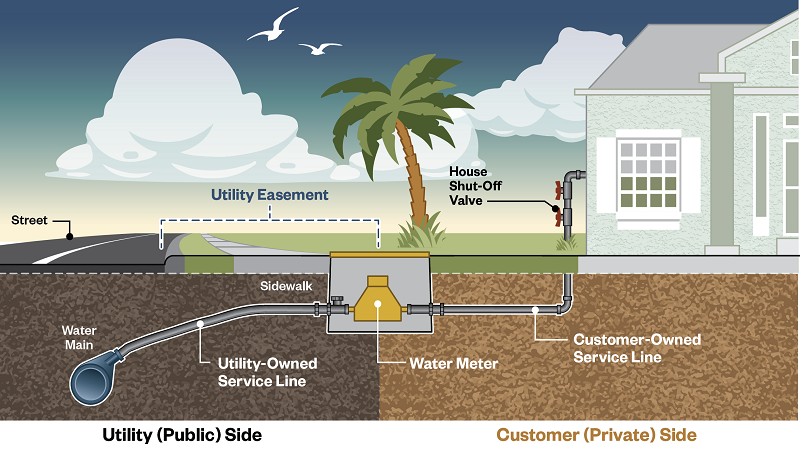
A water service line is an underground pipe that connects your home to the public water main. The service line conveys water from the main to the faucets, toilets, and other fixtures within your home.
The service line will typically enter your home through a hose bib, or outdoor faucet, connection typically located at the side of the house, or it will enter through the foundation in the crawl space, utility area, or other location.
There are currently no known lead pipes in WASD’s drinking water system. Miami-Dade County prohibited the use of lead in water pipe construction in 1976; therefore, the likelihood of finding lead service lines in our distribution system is low. In addition, the historical lead sampling performed by WASD for compliance with the original LCR has always been below the established trigger level of 10 parts per billion. We want to assure customers that Miami-Dade County regulates water chemistry by adding a corrosion inhibitor to ensure lead levels remain well below the federal regulatory limit when water leaves our treatment facility.
While lead levels in Miami-Dade County are not a public health concern, every utility in the country must complete the requirements associated with the LCRR/LCRI, including identifying the material of all unknown water service lines and having a plan in place to address the replacement of any lead pipes that may exist.
Water Quality
Lead can enter drinking water when plumbing materials that contain lead corrode over time. The rate of corrosion is based on the water chemistry.
At the Miami-Dade Water and Sewer Department (WASD), protecting public health and ensuring the safety of our community is our top priority. WASD is dedicated to the treatment and delivery of safe, high-quality drinking water to all our customers. Our County consistently meets or exceeds state, federal, and local drinking water standards. Water quality sampling results have shown that the water in our system does not corrode lead pipes. Part of our commitment to providing safe, high-quality water to our customers is minimizing the potential for corrosion.
All lead service lines have the potential to leach lead into drinking water, but we want to assure customers that Miami-Dade County regulates water chemistry by adding a corrosion inhibitor to ensure lead levels remain well below the federal regulatory limit when water leaves our treatment facility. WASD staff conducts more than 150,000 analyses of water samples each year, and our water sampling results show that our water does not corrode pipes. To learn more about our water chemistry and water testing, you can view our annual water quality reports.
Water quality tests are available for a fee at the retailers included in the National Environmental Laboratory Accreditation Program (NELAP). Visit the Florida Department of Environmental Protection webpage to find the laboratory closest to you. This test can be performed at home and will provide lead concentration results for the individual consumer.
To learn more about testing your drinking water, you can refer to this EPA fact sheet.
Service Line Identification & Self-Reporting Survey
Under both LCRR and LCRI, we are required by law to send an annual notification to all our customers with a service line that is listed as being made from an unknown material in our records. Letters were first sent out in November 2024. Since this is a yearly requirement, customers with unknown service lines will continue to receive these notifications each year around November until their service line is identified and confirmed to be non-lead.
The inventory map on the program webpage will let you know if the service line material of your property is still unknown. Type in your address and if a Gray Dot shows up, it means our records indicate your service line material is unknown. If your service line material is unknown, we then ask that you complete the self-reporting survey.
As part of our program outreach, WASD mails yearly notices to customers with unknown service lines, requesting participation in completing a service line identification survey.
Only customers at locations where the service line material is still unknown are being asked to complete the survey. WASD is mailing notices to customers with unknown service lines, requesting your participation to self-identify and complete the survey.
WASD is conducting a survey of water service line materials to identify infrastructure that has the potential to impact public health to ensure the continued safety of our water in compliance with the EPA’s updated regulations. We want to assure customers that Miami-Dade County regulates water chemistry by adding a corrosion inhibitor to ensure lead levels remain well below the federal regulatory limit when water leaves our treatment facility.
The portion of the water service line between your water meter and your home was not installed by the County, so there is limited information available about the service line material. This service line is privately owned and on private property, which WASD cannot access. By reporting the material of your service line, you are helping us identify any potential lead pipes in our water distribution system.
Instructions for identifying your service line material can be found here.
The survey results will be used to update our service line material inventory, which will be provided to the FDEP and posted online per the EPA’s requirements.
No personal information will be shared. Only public information regarding your service line material will be published on the program webpage and submitted to FDEP, as required by the EPA. This information includes the verified service line material, date of construction, and physical address. Responses will only be used for the purpose of complying with the LCRR/LCRI.
The best way to confirm that your contact information is up to date is by contacting our Customer Care Center.
Service Line Replacement
If your service line is identified as lead material, there is no immediate health concern. This does not necessarily mean that lead is in the drinking water. Notify WASD by completing the self-reporting survey.
For information on reducing potential lead in drinking water in your home, refer to the Educational Tools section on the program webpage.
When reported, WASD will follow up with you to verify that the service line is lead. If lead is encountered, the County will provide a point of use pitcher filter certified for both lead and particulate removal as an additional protective measure.
The self-reporting survey includes an option to request assistance with completing the survey and/or self-identifying your service line material. Please make sure to complete this information so we can follow up to provide support.
Following replacement, water quality sampling will be conducted to ensure lead levels are below the 10 parts per billion (ppb) level established by the EPA. As an additional protective measure, customers will receive a point-of-use pitcher filter that is certified for lead and particulate removal.
We are actively assessing the costs of complying with the LCRR/LCRI and determining funding options. More information will be provided when it is available.
The following link includes information on steps that can be completed to reduce lead exposure. Additionally, you can learn more by visiting the EPA website.
All program information including additional resources about lead exposure can be found on the program webpage.
You are now leaving the official website of Miami-Dade County government. Please be
aware that when you exit this site, you are no longer protected by our privacy or
security policies. Miami-Dade County is not responsible for the content provided on
linked sites. The provision of links to these external sites does not constitute an
endorsement.
Please click 'OK' to be sent to the new site, or Click 'Cancel' to go back.