
Top Services

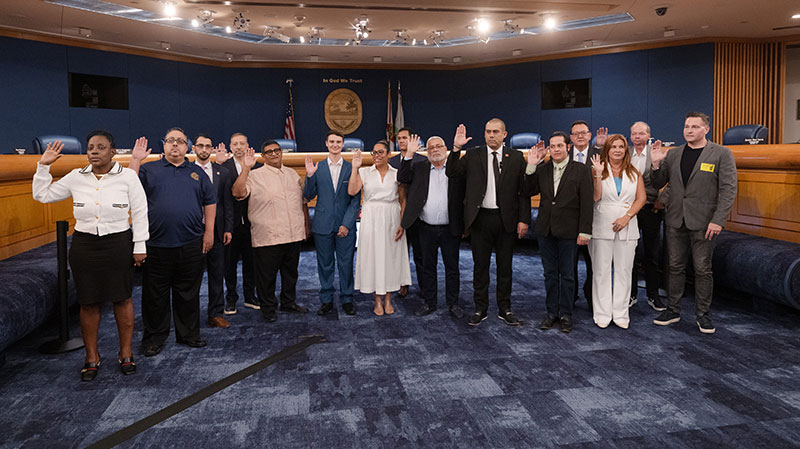
The 10 Community Councils, representing parts of unincorporated Miami-Dade County, make zoning and land use decisions and serve as advisory liaisons to the Board of County Commissioners and County staff.
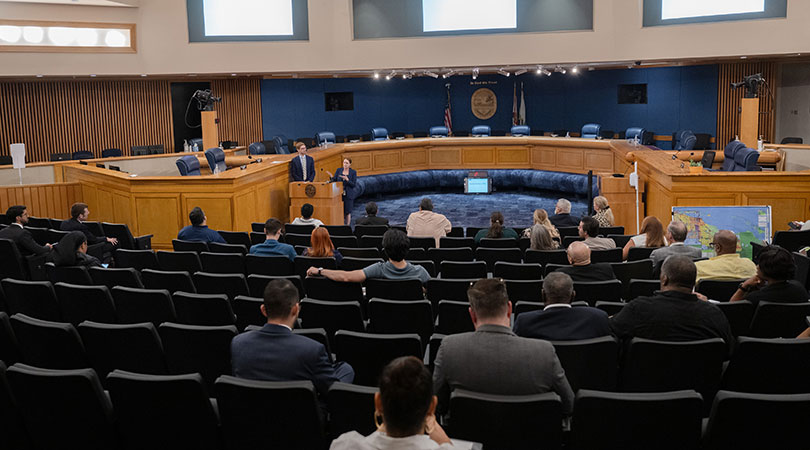
The Board of County Commissioners meets roughly once a month to make decisions on zoning matters.
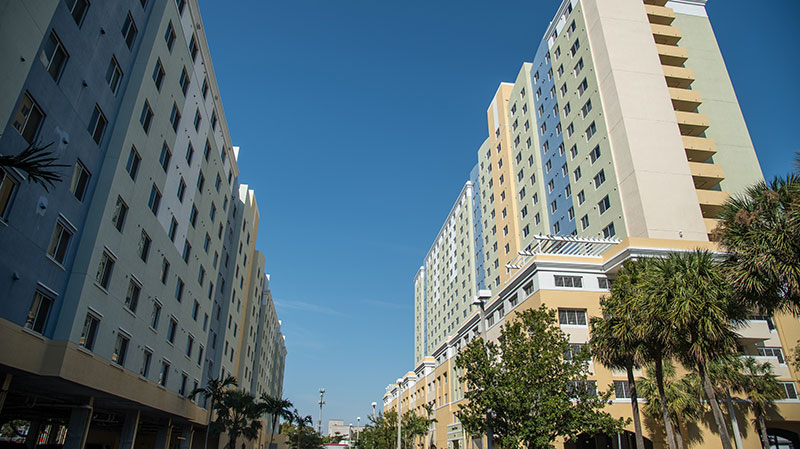
Each property within Miami-Dade County is assigned a zoning district classification, indicating the permitted land use activities and conditions under which those uses are allowed.

Platting is the mandatory legal process of dividing, subdividing, or combining land into officially recorded lots, blocks, and parcels, typically required before obtaining building permits for new developments.
Zoning Process

Certain applicants are required to follow a pre-application process, which provides them with initial comments that can assist with final submittals.
A Zoning Hearing is required whenever a property owner or lessee desires to change the use of land, as well as for proposed uses that have been disapproved by staff.
Certain Community Zoning Appeals Board decisions can be appealed to the Board of County Commissioners within 14 days after the action was taken.
The Zoning Evaluation process includes various types of analyses, reviews and recommendations.
Access a list of commonly-used zoning forms.
Get information on how to obtain written verification of a property's zoning.
Land Development Code
The Land Development Code of Miami-Dade County is available online under Chapter 33 of the County Code. To obtain a copy of the complete Miami-Dade County Code, call Municipal Code Corporation at 1-800-262-2633.
Access the Miami-Dade County CodeZoning Records
Access recent zoning applications and other related records.

Search zoning applications prior to September 2016 and other related files and submittals.

Search and subscribe to active zoning hearing updates.
Notices
The Live Local Act is a State of Florida law enacted through SB 102 (2023) and subsequently amended by SB 328 (2024), SB 1730 (2025) and HB 1389 (2026) to expand affordable and workforce housing by requiring administrative approval and providing zoning incentives for qualifying developments.
The Act primarily impacts local government land use authority through Sections 125.01055 and 166.04151, Florida Statutes, which govern counties and municipalities, respectively, and require administrative approval of qualifying projects while preempting certain zoning regulations related to use, density and height.
To assist applicants and the public, the County has prepared an initial memorandum outlining the original implementation of the Act, including eligibility criteria, development standards, and review procedures. Please refer to the Live Local Act Initial Implementation Memorandum (SB 102 – 2023).
Following subsequent legislative amendments, the County has also prepared an updated memorandum reflecting the most recent statutory changes, including modifications to development thresholds, preemption provisions, and development incentives. Please refer to the Live Local Act Updated Implementation Memorandum (SB 328 – 2024 / SB 1730 – 2025 / HB 1389 (2026)). For more information or assistance, email the Zoning-Development Services Division at [email protected] or call 305-375-2800.
For a current overview of projects utilizing the Live Local Act within Miami-Dade County, please refer to the Live Local Projects Tracking Table.
View the Department of Regulatory and Economic Resources' informational webinar on the Calusa zoning application, where staff reviewed the details of the County’s recommendation for this application.
The Department of Regulatory and Economic Resources hosts a quarterly forum for Affordable and Workforce Housing Developers. Department and other County staff discuss new ordinances, policy, permitting, regulations, plan review and more, to help developers navigate the housing development process.
On July 7, 2022, the Board of County Commissioners approved changes relating to impact fee exemptions for affordable and workforce housing development in the incorporated and unincorporated areas. The ordinance amends the Code of Miami-Dade County to expand the current impact fee exemption for affordable housing of up to 80% of the County’s Area Median Income (AMI) to now include housing developments targeted for housing for up to 120% of AMI.
The new impact fees exemption became effective beginning Aug. 8, 2022.
If you have any questions, please contact Impact Fees at 786-315-2670.
Rural Event Venues are permitted within the Agricultural Zoning District (AU) as long as the property qualifies under the standards set forth by Section 33-279 (8) of the Zoning Code. The ordinance defined Rural Event Venues as follows: a venue, located in an agriculturally zoned area, for special functions such as weddings, receptions, corporate meetings or similar gatherings.
On November 19, 2019 the Board of County Commissioners adopted Ordinance No. 19-112, comprehensively updating the regulatory framework governing the County airports – Miami International, Miami Executive, Opa-locka Executive and Miami Homestead General.
Said ordinance updates the land use, noise and heights/airspace regulations in and around County airports in order to guide development around them, safeguard airport users and neighbors, and secure airport operations and future growth.
Additionally said ordinance, which implements and is consistent with Chapter 333 of the Florida Statutes and the applicable Federal Aviation Administration rules and regulations, applies to both unincorporated and incorporated areas of the County.
Meetings and Events
More Services
This voluntary program provides developers with density bonuses and other incentives for the development of workforce housing.
Whether you are applying for a zoning change, exploring options for your property or simply trying to understand the zoning process, the Homeowners Assistance Program provides free guidance and support.
County landscape regulations incorporate Florida Friendly Principles and strict water-efficiency measures for homes, common areas and rights-of-way.
Certain special events are allowed in the Agricultural Zoning District, such as weddings, receptions, corporate meetings or similar gatherings.
Impact fees are paid by developers to help fund the additional expenses required for services for new development, such as roads, parks, schools and public safety.

About Us
The Department of Regulatory and Economic Resources' mission is to enhance and protect the quality of life in Miami-Dade County through visionary planning, efficient land development and sound regulation that foster resilience, sustainable growth and long-term economic vitality.

Regulatory and Economic Resources
Lourdes M. Gomez
Stephen P. Clark Center
111 NW 1st Street,
11th Floor
Miami, FL 33128
305-375-2877 | [email protected]
Herbert S. Saffir Permitting and Inspection Center
11805 SW 26 Street,
Miami, FL 33175
786-315-2000